
The Street Sign Falls out of Line
Anomaly Reports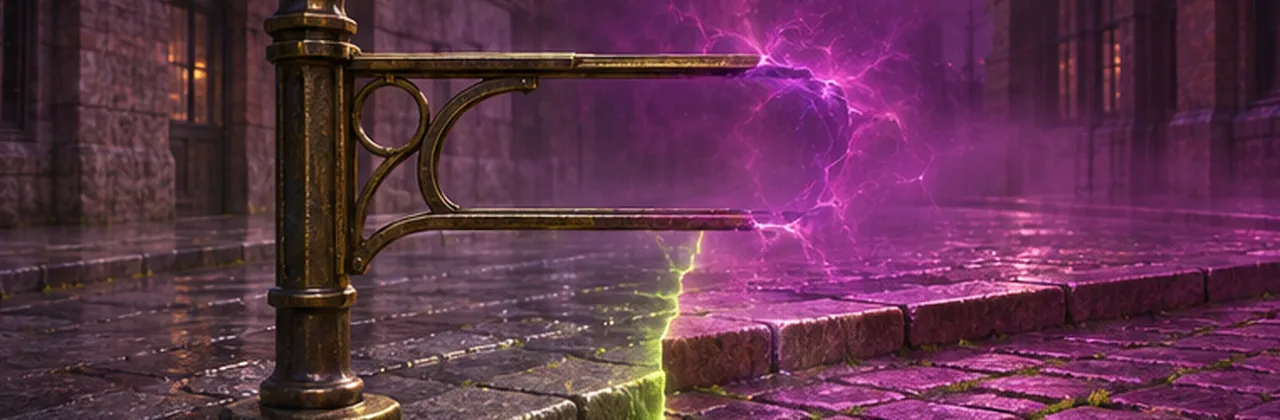
Find a sign face in a wide picture
From the bottom of Finch Street a post rises beside the pavement. A little above it you can see a blank sign that seems to sit across both sides of the tear. The closer street shows one length of its support and the farther one shows a second section. We drew the halves in nearly the same location in the first image. They seemed to make an unbroken sign even after the two curbs had begun to separate.
Move one side at the same height
The new picture shifts the farther sign toward the storefront and leaves the closer post next to the curb. Its upper edge remains almost as high as the earlier one. From a distance that difference seems small. Look along the lower edge of the road and the two supports take different positions. The curb supplies an earlier part of the view to check before relying on the top of the sign.
Use the arcade to recover the perspective
As the traveler nears the tear, one stone column moves past the nearer section of the sign. The reflection on the other side still suggests there could be a post in that space. Step back into the arcade and both curbs and the column become visible together for a short while. Bring the more distant sign into the same narrow opening. Its support can be compared with the far wall without looking through the closer one.
Compare the sign before and after carrying the object
One Object Across Finch Street creates a reason to approach the offset from two different directions. Start below the shutter and use the earlier curb as a stable shape. When you arrive on the other side, look at the blank frame over the road and place the first curb in relation to it. The object fitting appears beside a similar part of the building but farther from the sign. The same shade of purple should not make those places seem identical.
Show a thin shadow on the frame
We first made the sign look too clean and flat in the middle of the tear. A dark side on the nearer frame now reveals where its angle begins to change. The farther frame catches a little more light along its lower edge. The two are readable as different sizes without an arrow or painted number. As the camera approaches at a slant, the first shadow becomes visible before the reflected version moves behind the curb.
Take a separate measurement at the stairs
A Seam across the Stair Rail follows details closer together than the signs. There the view needs a different way to show which surface has moved. At the street, the long line of pavement can run out of the picture while the two frames remain in view. At the stairs, the small gap matters more than the overall view. It is useful to test where a stable point in each starts giving enough information to compare the objects.
Record an angle from close to the wall
In this position one part of the offset vanishes behind the stone. A narrow gap near the base of the sign still indicates which part is on the different side. Look up from the curb after finding that gap. The person can recover most of the sign in a wider view soon afterward. The approach should give a little evidence from more than one distance so a person can check a mistaken angle without retaking the entire route.
Notice what's still there once the repair is done
Read Back the Closed Corner shows the repaired street from a place where the first curb and the old wall are still recognizable. The signs do not have to become identical to make that change clear. Anomaly Reports ties the offset to its earlier appearance. It gives the workshop evidence of a recognizable difference that can survive after the main route becomes more legible.